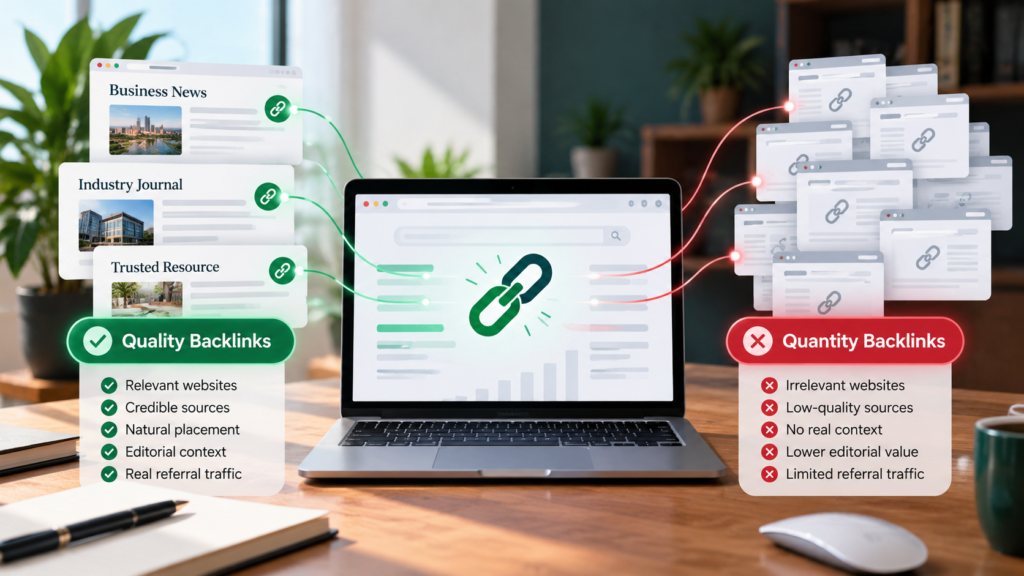
Backlinks help connect websites and can help search engines discover pages across the web. However, building a strong backlink profile involves more than collecting a high number of links. Relevance, credibility, editorial context, and the value a link provides to readers are also important considerations. When comparing quality backlinks vs. quantity, quality should generally be the priority for sustainable SEO.
Relevant, naturally earned backlinks can help people discover useful resources, while a large number of unrelated links does not guarantee better search rankings. An effective link-building strategy focuses on earning meaningful links and evaluating their contribution to overall website performance. A reliable SEO agency in Adelaide can help businesses build a stronger backlink profile by prioritising relevant websites, useful content and sustainable link-building practices.
Understanding Backlink Quality and Quantity
Backlink quality refers to the relevance, credibility and context of a link pointing to your website. For example, a building company earning a backlink from a relevant home improvement publication may help readers discover its renovation guide.
Backlink quantity refers to the total number of links pointing to a website. However, more links do not automatically mean better SEO results. Businesses should prioritise relevant, naturally earned backlinks that provide genuine value to readers rather than focusing only on link numbers.
What Makes a Backlink High Quality?
A high-quality backlink generally comes from a relevant website, appears naturally within useful content, and provides a meaningful reference for readers. Its potential value depends on the overall context rather than one isolated SEO metric.
Important factors include:
- Relevance: The referring website and surrounding content relate to your industry, subject, or audience.
- Credibility: The website publishes useful information and has a genuine purpose beyond selling links.
- Natural placement: The link fits logically within the surrounding content.
- Editorial context: The link supports a reference, explanation or recommendation that benefits readers.
- Referral potential: The link could attract visitors who are genuinely interested in your content, products or services.
For instance, an accounting firm may benefit from a contextual backlink in an article about small-business finances. The link connects readers with a relevant service or resource. An unrelated link placed on a website solely because of its high third-party authority score may offer less practical value.
SEO tools can help evaluate backlink opportunities, but their authority scores are third-party estimates rather than direct Google ranking scores. Businesses should assess relevance, editorial quality, and the purpose of a link instead of relying exclusively on numerical metrics.
Quality Backlinks vs Quantity: Which Matters More?
Quality backlinks are generally a better priority than simply increasing backlink numbers. Relevant, credible links can help people discover useful content and may attract relevant referral traffic. However, no individual backlink guarantees improved rankings.
The main differences between quality and quantity are outlined below.
| Factor | Quality backlinks | Backlink quantity |
| Relevance | Emphasises links related to your industry or content | Counts links regardless of relevance |
| Editorial value | Considers whether a link genuinely supports the content | Does not establish why a link was created |
| Referral traffic | Focuses on the potential to attract relevant visitors | Does not indicate visitor interest |
| Measurement | Requires reviewing link context and source quality | Provides a numerical link count |
| Sustainable SEO | Prioritises relevant, naturally earned links | Can support monitoring when growth is natural |
Consider two businesses competing in the same industry. The first earns several relevant links from publications that reference its original research. The second acquires hundreds of unrelated links through low-quality link-building services.
The first business may have a more relevant backlink profile and better opportunities for referral traffic, despite having fewer links. Actual SEO performance will still depend on other factors, including content relevance, competition, and overall website quality.
The goal is not to avoid acquiring more backlinks. It is to allow backlink quantity to grow through useful content, genuine relationships, and relevant editorial references.
Does Backlink Quantity Still Matter for SEO?
Backlink quantity still provides useful information when monitoring how a website’s link profile develops. However, the total number of links should not be treated as a standalone measure of SEO success.
Businesses should distinguish between total backlinks and referring domains. Backlinks count individual links, while referring domains count the unique websites linking to a page or website. Reviewing both measurements can provide a clearer picture of link acquisition.
For example, a website might receive multiple backlinks from one publication. Another website might receive links from several relevant publications. The totals alone do not establish which profile is more valuable; the context and quality of those links also matter.
Instead of setting an arbitrary backlink target, businesses should monitor new and lost links, evaluate referring domains and consider whether their link-building activities attract relevant visitors.
How to Build Quality Backlinks for Sustainable SEO
A sustainable link-building strategy gives other websites a genuine reason to reference your content. The following methods can help businesses identify relevant opportunities without prioritising link numbers over usefulness.
Create Valuable Content That Earns Links
Useful content gives publishers and website owners something worth referencing. Original research, detailed guides, practical checklists and industry insights can attract relevant backlinks when they answer questions or provide information that readers need.
For example, a business could publish a detailed guide addressing a recurring problem in its industry. If the guide contains accurate explanations, practical steps and useful supporting information, other relevant websites may reference it in their own content.
Focus on accuracy, clarity and audience needs. Update information when necessary, and avoid creating pages solely to attract backlinks.
Earn Relevant Links Through Outreach
Outreach involves contacting relevant publishers, website owners and industry professionals to introduce useful resources. Effective outreach explains why a resource could benefit the recipient’s audience instead of relying on generic link requests.
Guest contributions, digital PR and professional relationships can create opportunities to earn editorial links when they provide genuine value. Guest content should be useful in its own right rather than produced mainly to insert backlinks.
For businesses seeking professional support, SEO Agency Adelaide can focus link-building efforts on relevant opportunities, useful content and long-term website growth.
Build Relationships Within Your Industry
Professional relationships can help businesses share expertise, contribute information and identify opportunities for editorial references.
Businesses can participate in relevant industry discussions, provide expert commentary and collaborate on resources that serve a shared audience. These activities should focus on genuine collaboration rather than exchanging links solely to influence search rankings.
Over time, useful contributions can help a business become a recognised source of information within its industry.
How to Evaluate Your Backlink Profile
Backlink analysis helps businesses understand where their links originate, how their link profile changes and which areas may need further investigation. A useful review looks at patterns and context instead of automatically removing every unfamiliar link.
When evaluating your backlink profile, consider the following factors:
- Website relevance: Check whether referring websites relate to your industry, subject or audience.
- Content quality: Assess whether the referring website publishes useful and credible material.
- Link placement: Review whether the link fits naturally within the surrounding content.
- Referring domains: Monitor new and lost referring domains to understand where links originate.
- Referral traffic: Check whether backlinks bring visitors who may find your website useful.
- Organic search performance: Use Google Search Console alongside suitable SEO tools to monitor organic search trends.
Reviewing these factors together provides a more complete picture than relying on a single authority metric or backlink total. If you discover suspicious links, investigate their source and context before taking action. A third-party SEO tool labelling a link as toxic does not automatically mean it must be removed or disavowed.
Google’s spam policies identify link-building practices that aim to manipulate search rankings as potential violations. The disavow tool should not be used for routine backlink maintenance; businesses should investigate suspicious links carefully and consider disavowing them only in specific situations involving substantial unnatural links and a risk of manual action.
Backlink Practices to Avoid
Some link-building practices focus on manipulating search rankings instead of helping users discover relevant resources. These approaches can create unnecessary risks and may conflict with Google’s spam policies.
Businesses should avoid:
- Buying backlinks in bulk to manipulate search rankings.
- Using automated services that generate links without considering relevance.
- Participating in excessive link exchanges primarily to influence rankings.
- Publishing low-quality guest posts mainly to insert backlinks.
- Repeatedly using exact-match anchor text in ways that create an unnatural linking pattern.
A large backlink count does not automatically indicate a policy violation. The source, context, and purpose of the links matter.
A more sustainable approach prioritises relevant websites, useful content and genuine editorial recommendations. Evaluate opportunities carefully and focus on the value they provide to readers rather than treating every new backlink as a success.
Building a Sustainable Backlink Strategy
Sustainable link building is about developing a backlink profile that reflects the usefulness and relevance of your website. Businesses should create resources worth referencing, build relationships with relevant publishers, and review backlink performance as part of their wider SEO strategy.
Quality and quantity are not mutually exclusive. A website can earn more backlinks over time while maintaining relevance and editorial integrity. The key is to let genuine value drive that growth instead of treating link numbers as the primary measure of success.
Ready to strengthen your website’s backlink profile? Contact SEO Agency Adelaide to discuss a practical link-building strategy focused on relevant opportunities, useful content, and sustainable SEO growth.